
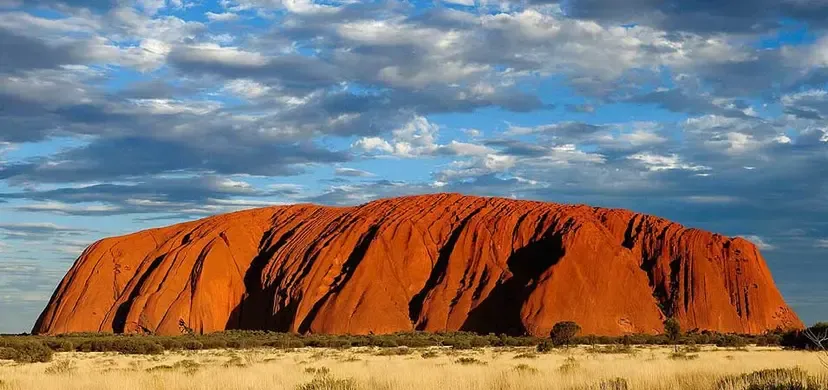
Uluru: The Sacred Heart of Australia’s Red Centre
Rising from the heart of Australia’s Red Centre, Uluru is not just a monolith; it is a living legend. Sacred to the Anangu people, this massive sandstone rock holds stories that have been shared for thousands of years. Standing alone in a vast desert plain, it commands attention in a way that photographs can never fully capture.
For travelers seeking a journey that is as much cultural as it is scenic, Uluru offers a rare chance to connect with one of the world’s oldest living cultures.
A Monolith Rich in Meaning
Uluru stands about 348 meters tall and measures more than 9 kilometers around its base, but what you see above ground is only part of the story. Geologists believe much of the rock extends deep beneath the desert sand. It is located within Uluru-Kata Tjuta National Park, a UNESCO World Heritage Site recognized for both its natural beauty and its profound cultural significance.
For the Anangu, the traditional owners of the land, Uluru is not simply a landmark. It is a place of law, learning, and spiritual connection, cared for across countless generations.
The Dreamtime Stories
According to Aboriginal Dreamtime beliefs, Uluru was created by ancestral beings during the creation period. Every cave, crack, and curve on its surface tells a story of the spirits that shaped the land. In this worldview, the landscape is not a backdrop to history; it is the living record of it.
Among the many stories associated with Uluru:
- The battle of the serpent spirits: One legend describes a fierce fight between two serpent spirits, whose struggle left deep scars on the rock’s surface.
- The Mala people: Another tells of the Mala people, whose rituals were interrupted by evil forces, with echoes of that story still lingering on Uluru’s surface.
Some stories are shared openly with visitors, while others are sacred and kept within the Anangu community. Respecting this distinction is part of understanding the place.
A Place of Reverence
For visitors, Uluru is not only a natural wonder but also a place of reverence. In 2019, climbing the rock was permanently closed out of respect for Anangu wishes and cultural beliefs, as well as for safety and environmental reasons. Today, visitors experience Uluru by walking around its base, learning from Indigenous guides, and appreciating its stories from the ground.
Some areas around the rock are considered sacred, and photography is restricted in certain places. Signs along the walking tracks explain where photos are not permitted, and following them is a simple way to show respect.
Sunrise and Sunset: A Sacred Performance
Watching Uluru glow red at sunrise or fade into purple at sunset feels like witnessing a sacred performance crafted by the earth itself. As the light changes, the rock shifts through shades of ochre, orange, crimson, and deep violet, and the desert falls into a hush.
The most popular viewing points include:
- Talinguru Nyakunytjaku: A dedicated sunrise viewing area with walkways and views of both Uluru and Kata Tjuta.
- Uluru Sunset Viewing Area: A classic spot to watch the colors deepen as the day ends.
- Sounds of Silence dinner: A dining experience under the stars, with a stargazing session led by an astronomer.
Things to Do Around Uluru
- Base Walk: A walk of about 10 kilometers around the rock, passing waterholes, caves, and rock art. It can also be enjoyed in shorter sections.
- Mala Walk: A guided walk led by Indigenous rangers or storytellers, sharing the Mala story and the cultural importance of the area.
- Kata Tjuta (The Olgas): A striking group of domed rock formations nearby, with beautiful walks such as the Valley of the Winds.
- Cultural Centre: Learn about Anangu art, history, and traditions, and meet local artists.
- Camel and Segway tours: Unique ways to see the landscape from a different perspective.
- Field of Light: A large-scale art installation of thousands of glowing lights spreading across the desert at night.
The Best Time to Visit
- May to September (cooler months): Daytime temperatures are comfortable for walking, though nights can be surprisingly cold.
- October to April (hotter months): Temperatures can be extremely high, so most outdoor activities are best done early in the morning or late in the afternoon.
Travel Tips
- Start early. Sunrise walks avoid the midday heat and offer the best light for photography.
- Carry plenty of water. The desert is dry and hot, and dehydration can come quickly.
- Protect yourself from the sun and flies. A wide-brimmed hat, sunscreen, and a fly net are very useful.
- Wear sturdy shoes. Walking tracks are mostly flat, but the ground can be rough and sandy.
- Learn before you go. Taking a guided cultural tour helps you understand the deeper meaning of what you are seeing.
- Respect local customs. Follow all signs, stay on marked paths, and observe photography restrictions.
Entering the Dreamtime
Standing before Uluru means entering the Dreamtime, a realm where myth and landscape merge, and stories echo through the desert winds. It is a place that asks visitors not just to look, but to listen, and to leave with a deeper respect for the land and its people.
Long after the colors of sunset have faded, the quiet power of Uluru stays with you, a reminder that some places are not simply visited but felt.
OXFORD STAR TRAVEL
Dubai • UAE
Exclusive Airline Fares & Charter Flights
Air Arabia Charter
Airtour Istanbul Charter
flydubai Charter
SalamAir Special Fares
Iran & Middle East Travel Specialist