The Odyssey and Odysseus’s Journey: What Modern Travelers Can Learn from the World’s Greatest Adventure
For thousands of years, The Odyssey has inspired readers with its tales of storms, mythical creatures, distant islands, and the relentless desire to return home. Written by Homer around the 8th century BCE, the epic follows Odysseus, king of Ithaca, as he struggles to return from the Trojan War.
While scholars continue to debate the exact historical geography of the voyage, the story remains deeply connected to the Mediterranean world. For modern travelers, The Odyssey offers something surprisingly familiar: curiosity, uncertainty, cultural encounters, and the transformative power of travel.
In this guide, we explore the legendary route of Odysseus, the real Mediterranean destinations associated with his journey, and why this ancient story still resonates with today’s explorers.
What Is The Odyssey?
The Odyssey is one of the two great Greek epics traditionally attributed to Homer. It begins after the fall of Troy and recounts the ten-year journey of Odysseus back to Ithaca, where his wife Penelope and son Telemachus await him.
The epic combines:
- Adventure travel
- Seafaring exploration
- Encounters with foreign cultures
- Survival against natural forces
- Personal growth through hardship
In many ways, it is the world’s first grand travel memoir.
The Legendary Route of Odysseus
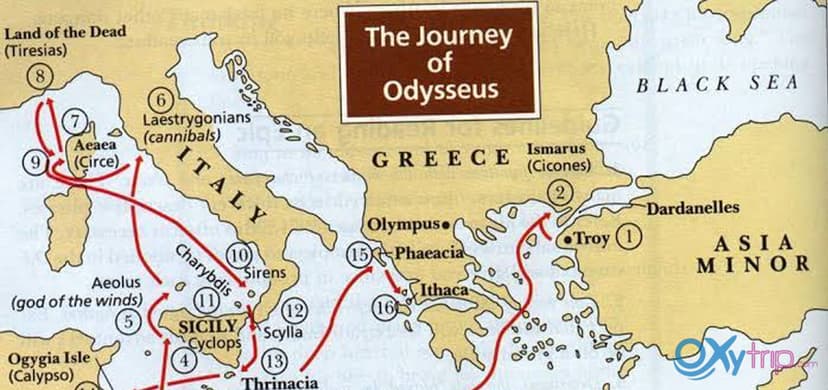
Historians cannot map the journey with complete certainty, but several Mediterranean locations have long been associated with episodes from the epic.
Troy (Modern Türkiye)
Odysseus departs from the region of Troy, near present-day Çanakkale in northwestern Türkiye. The archaeological site of Hisarlik is widely identified with ancient Troy and is now a UNESCO World Heritage Site.
Ismarus and the Land of the Cicones
Often linked to the Thracian coast of northern Greece, this episode reminds travelers that the first stop after a long journey is not always the easiest.
The Lotus-Eaters
Possibly inspired by parts of North Africa, the Lotus-Eaters symbolize the temptation to abandon one’s goals and lose oneself in comfort.
The Island of the Cyclops
Many traditions connect this episode with Sicily, particularly the area around Mount Etna, where dramatic volcanic landscapes still evoke the wildness described in the myth.
Aeolia, Home of the Wind God
The Aeolian Islands north of Sicily are frequently associated with Aeolus, keeper of the winds. Their rugged coastlines and powerful sea breezes make the connection easy to imagine.
Circe’s Island
Some classical writers identified Aeaea with Monte Circeo on Italy’s western coast, a striking headland surrounded by the Tyrrhenian Sea.
The Sirens
The seductive songs of the Sirens have been linked to the Amalfi Coast and the waters near Sorrento, where steep cliffs rise dramatically above the sea.
Ithaca
The journey finally ends on Ithaca, one of Greece’s Ionian Islands, celebrated for its peaceful coves, hiking trails, and authentic village atmosphere.
A Modern Odyssey Through the Mediterranean
Travelers inspired by Homer can follow a loose contemporary itinerary through several remarkable destinations.
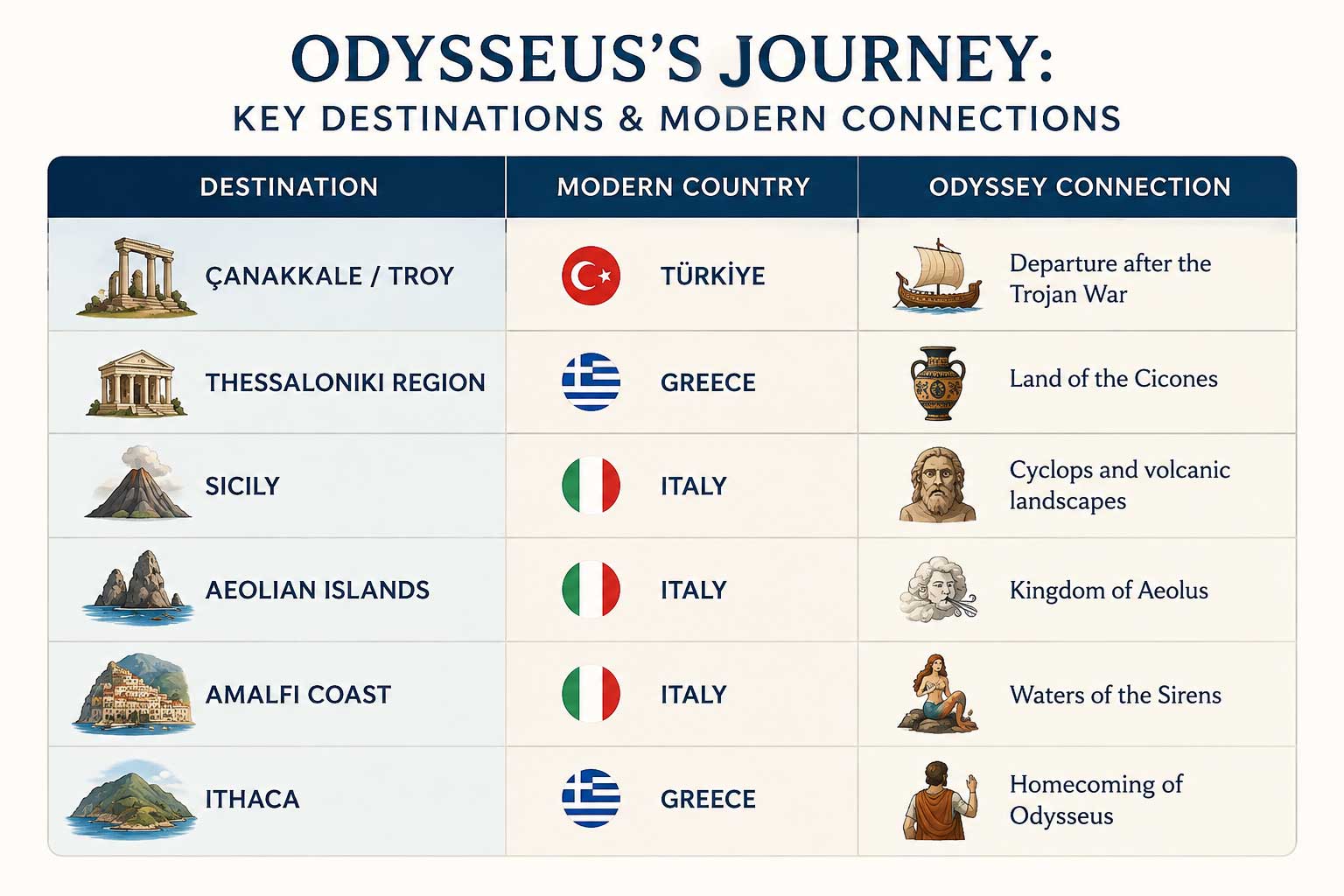
This route combines ancient history, island culture, coastal scenery, and Mediterranean cuisine, making it ideal for travelers interested in both mythology and real-world exploration.
Travel Lessons from Odysseus
1. Every Journey Changes You
Odysseus leaves Troy as a victorious warrior but returns as a wiser, more patient leader. Long journeys often reshape our priorities in unexpected ways.
2. Curiosity Has Consequences
Many of Odysseus’s troubles begin with the desire to explore what lies beyond the horizon. Responsible travel requires balancing curiosity with respect for local environments and cultures.
3. Home Is Part of the Adventure
Unlike many heroic epics that focus on conquest, The Odyssey emphasizes returning home. Modern travelers often discover that the meaning of a trip becomes clear only after they return.
4. Stories Matter as Much as Destinations
Few travelers visit the exact places Homer imagined, yet millions remain fascinated by the journey because of the stories attached to the landscape. Cultural narratives can transform ordinary coastlines into unforgettable experiences.
Best Mediterranean Destinations for Odyssey Fans
Ithaca, Greece
Ideal for travelers seeking quiet beaches, hiking, sailing, and authentic Greek island life.
Lipari and the Aeolian Islands, Italy
Perfect for volcano enthusiasts, boat trips, and dramatic coastal photography.
Sorrento & the Amalfi Coast, Italy
A great choice for combining mythology, seaside scenery, historic towns, and Italian cuisine.
Troy Archaeological Site, Türkiye
Best for travelers interested in ancient civilizations, archaeology, and the historical background of Homeric legend.
Why The Odyssey Still Inspires Travelers
More than 2,700 years after it was composed, The Odyssey continues to influence literature, film, psychology, and travel culture. Its enduring appeal comes from a simple truth: travel is never only about reaching a destination.
Odysseus faces:
- unpredictable weather,
- unfamiliar customs,
- moments of fear,
- unexpected hospitality,
- and the constant challenge of deciding who he wants to become.
These experiences remain familiar to anyone who has boarded a plane, sailed to a new island, or wandered through a foreign city without knowing exactly what awaits around the next corner.
Planning Your Own Odyssey-Inspired Trip
Suggested 10-Day Itinerary
Days 1–2: Çanakkale and Troy, Türkiye
Days 3–5: Catania and Mount Etna, Sicily
Days 6–7: Lipari and the Aeolian Islands
Days 8–9: Sorrento and the Amalfi Coast
Day 10: Fly to Kefalonia and ferry to Ithaca
This itinerary works particularly well in April–June and September–October, when Mediterranean weather is pleasant and major tourist sites are less crowded.
Final Thoughts
The Odyssey is often remembered for its monsters and myths, but at its heart it is a story about navigation, resilience, temptation, discovery, and the longing for connection. Whether or not Odysseus sailed the exact routes described by Homer, the Mediterranean still offers countless opportunities to experience the spirit of his adventure.
For modern travelers, the greatest lesson of Odysseus’s journey may be this:
The value of travel lies not only in the places we reach, but in the wisdom we gain while finding our way through the unknown.